The ten-second test
Stand at the bottom of your stairs and look up. If you can see the top step from the
bottom in one unbroken line, you need a straight stairlift. If the stairs bend, turn a
corner, or stop at a landing part way up, you need a curved one. It is the rail that decides, and
the rail has to follow your staircase exactly.
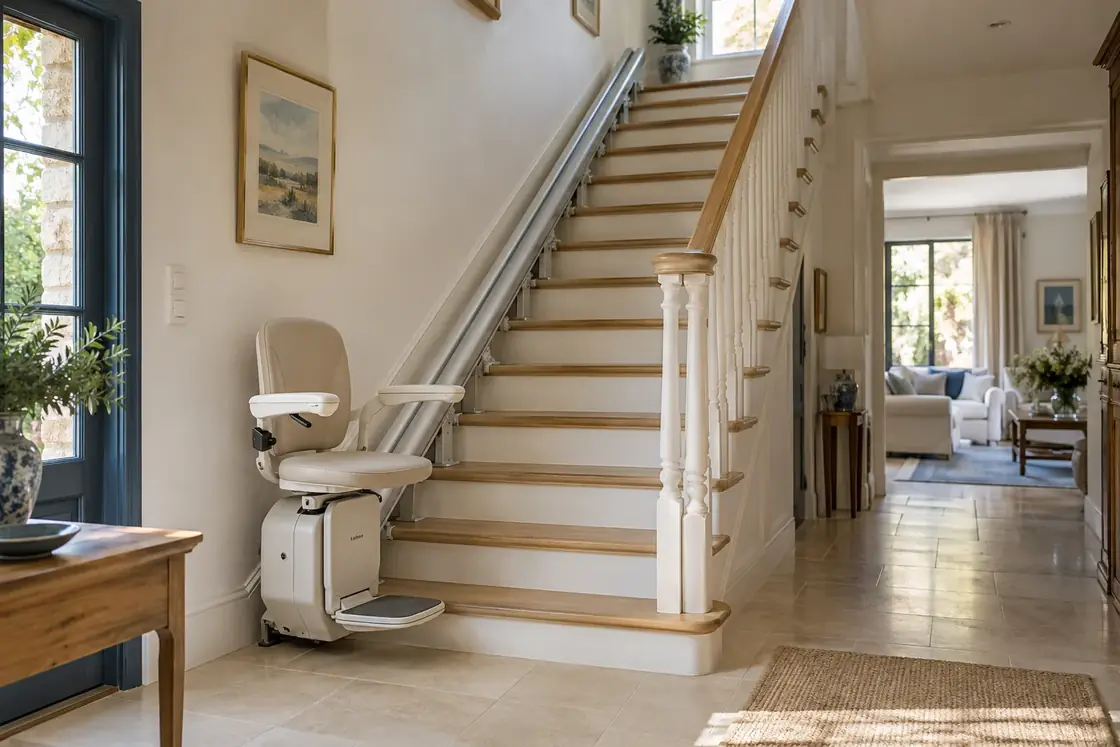 StraightOne unbroken flight. The rail runs in a single line, so it is cut from stock.
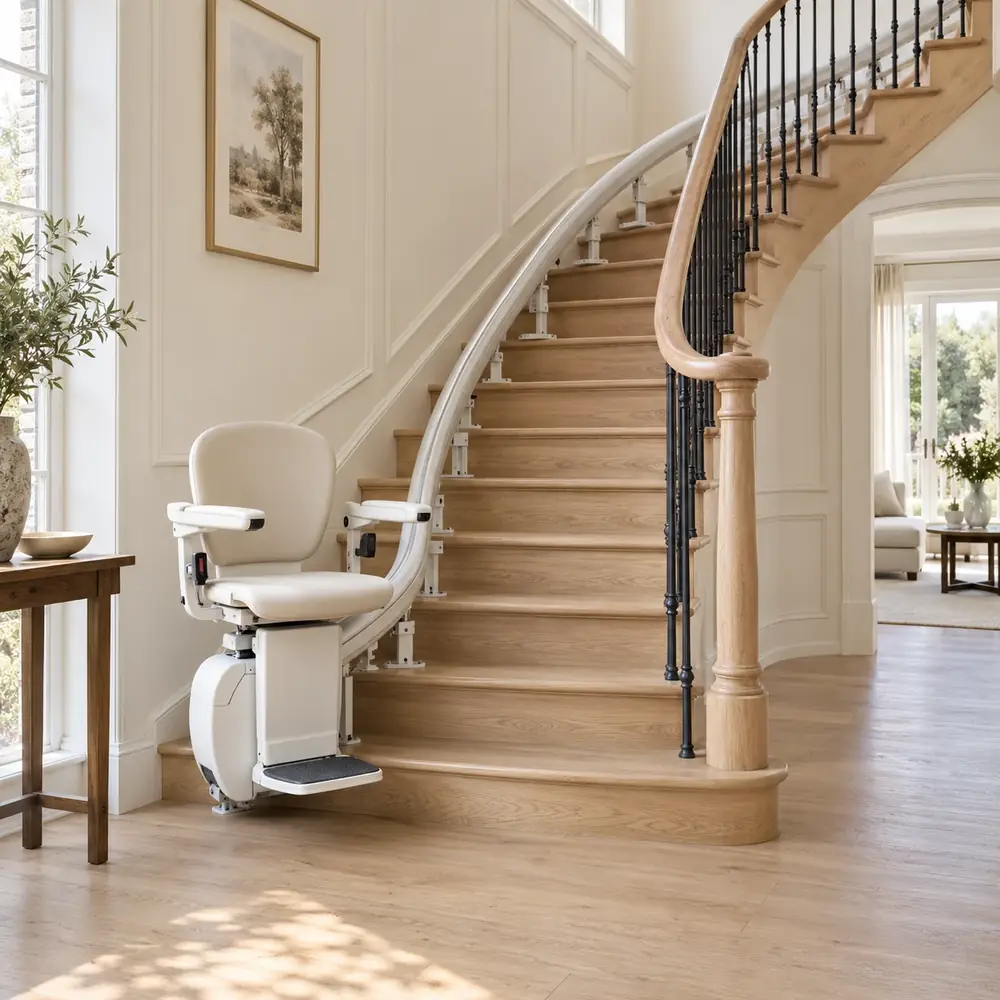 CurvedThe stairs turn, so the rail has to bend with them - and that rail is made for your staircase alone.
Get your price in about 60 seconds
Tell us your staircase and we will show you what installers near you charge
for it. Start with the shape - it is the part that matters most.
What the difference costs
Straight and curved stairlifts compared
| Straight | Curved |
|---|
| Cost | The lower of the two | Noticeably higher - the rail is bespoke |
| The rail | Cut from stock | Surveyed and made for your staircase |
| Time to install | Often within days | Usually a few weeks |
| Fitting itself | A couple of hours | Half a day or more |
| Reconditioned available? | Widely | Rarely, and the saving is smaller |
| Rental available? | Commonly | Seldom |
The gap is not the manufacturer being difficult. A straight rail is a standard part cut to length. A
curved rail is a one-off: someone surveys your staircase, the rail is designed around it, then
manufactured, then fitted to that house and no other. You are paying for a bespoke piece of engineering,
which is also why it takes longer to arrive.
How big that difference is depends on your staircase, the model and the installer, which is why we do
not publish a single figure - it would be wrong for most people. Fill
in the short form and we will show you the guide price for your own stairs, free and with no
obligation.
What counts as "curved"
People often assume their stairs are straight because the flight itself looks straight. These all
need a curved rail:
- A half landing - the stairs go up, you turn 180 degrees on a flat landing, then
carry on up.
- A quarter landing - a 90-degree turn part way up.
- Winder steps - wedge-shaped steps that fan round a corner instead of a landing.
- A curve at the top or bottom only - even two or three turning steps mean the
rail has to bend.
- Spiral stairs - always bespoke, and not every installer will take them on.
If you are unsure, take a photo from the bottom and one from the top. Any installer worth using will
tell you from those two pictures.
The option most people are not told about
If your staircase has a proper flat landing part way up, you may not need a curved lift at all.
Two straight stairlifts - one for each flight, stepping off and on at the landing - can
come in well under the price of a single curved lift, and both can be fitted from stock in days rather
than weeks.
There is one condition, and it is not negotiable: the user has to be able to stand, turn, and walk a
few steps across the landing safely on their own. If that is doubtful now, or likely to become doubtful,
a single curved lift is the right choice even though it costs more. This is exactly the sort of thing to
put to an installer at the survey rather than deciding on your own.
Things that change the price either way
- A door or radiator at the bottom. Where the rail would end across a doorway,
installers fit a hinged section that folds out of the way. It is a common, solvable problem - just
mention it when you get quotes.
- Which way the seat needs to face at the top. Getting off safely at a landing
sometimes needs a powered swivel seat.
- Rail overrun. On some staircases the rail has to run slightly past the top step,
which needs the space to exist.
- Narrow stairs. Under about 70cm, not every model will fit, which narrows your
choice and can raise the price.
- Outdoor lifts - to a front door or garden - are weatherproofed and priced
separately again.
Reconditioned: better value on straight than curved
A reconditioned straight stairlift can be a genuinely good buy. The rail is cut down from a
previously used one, the carriage is refurbished, and the saving against new is real.
Curved is a different story. A used curved rail was shaped for one specific staircase and almost
never fits another, so even a "reconditioned" curved lift usually needs a new rail - which is the
expensive part. Expect the discount to be modest. If someone quotes you a curved lift at a
straight-lift price, ask exactly which parts are used and what the warranty covers.
See what your staircase actually costs
We do not publish a single price because it would be wrong for most staircases. Tell us about
yours and installers who cover your postcode will tell you what it costs.
Get My Free Guide Price
Frequently asked questions
How do I know if I need a straight or curved stairlift?
Stand at the bottom and look up. One unbroken line to the top with no bend, corner or landing
means straight. Any turn, landing or fanned steps means curved. The rail has to follow the
staircase exactly, so it is the stairs that decide, not the room.
Why are curved stairlifts so much more expensive?
The rail is made to measure for your staircase and no one else's - surveyed, designed,
manufactured, then fitted to that one house. That is also why it takes longer to arrive. How much more
depends on your staircase and the installer, so the only number worth having is one for your own
stairs - fill in the short form and we will show you your
guide price.
Can I put two straight stairlifts on a staircase with a landing?
Often yes, and it can cost considerably less than one curved lift. The condition is that the
user can stand, turn and walk a few steps across the landing unaided. If that is doubtful, a
single curved lift is the right answer.
How long does a stairlift take to fit?
A straight lift is usually in within days - the rail is stock and the fit takes a couple of
hours. A curved lift normally takes a few weeks because the rail is made for your staircase
first.
Will a stairlift block my hallway or a door at the bottom?
It can, and it is easily solved with a hinged or folding rail section that lifts out of the
way. Mention any door, radiator or cupboard near the bottom step when you get quotes.
Can I get a reconditioned curved stairlift?
Rarely. Used curved rails were shaped for one house and seldom fit another, so the rail is
usually new and the saving is much smaller than on a straight lift.